
How to deal with negative people at work
Last week during a presentation, an audience participant asked me a question that comes up regularly.
“How do I deal with those 10% of people who are always negative and seem to consume 90% of my time ?”
First off—great question ! Secondly, because it’s a common issue, here’s my step-by-step approach to dealing with negativity and negative people.
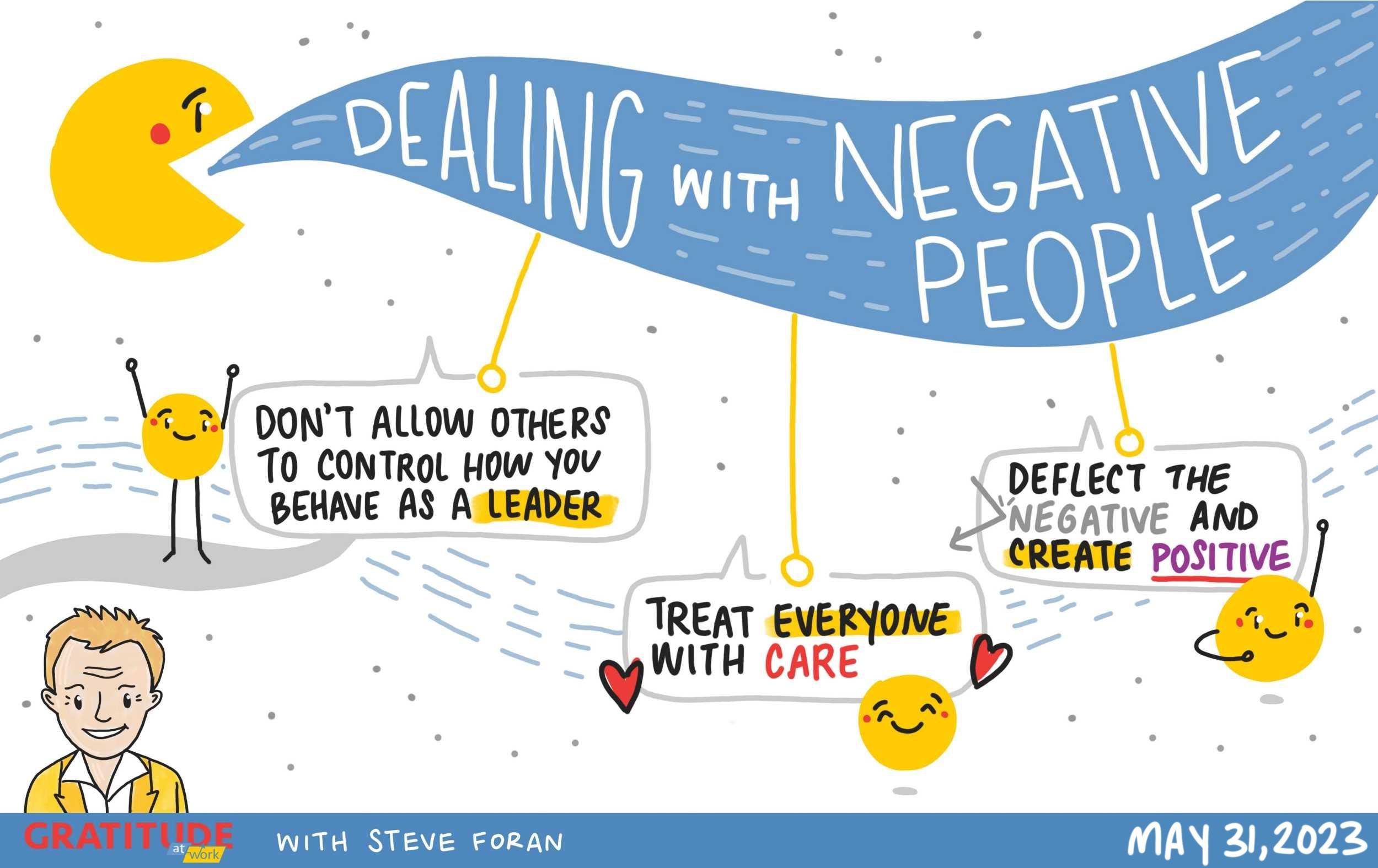
Don’t allow others to control how you behave as a leader. If you want to show up as an inspiring, grateful-minded human being, then commit to doing so regardless of how others show up or treat you. It’s easy to be inspiring when the people around you are uplifting and positive. Your true leadership is revealed in challenging circumstances.
Treat everyone with care—in honour of their human dignity. This applies regardless of how someone performs, progresses toward goals, supports or hinders your mission or whether or not you enjoy being around them. This is tough but treating people with genuine care is a non-negotiable tenet of inspiring leadership.
Deflect the negative and create positive. When the negative person approaches and shares, “I can’t believe what they’re doing, rant rant rant rant rant rant.” I make two statements and ask one question:
I acknowledge them to ensure they feel heard.
I share a relevant and poignant gratitude from my day. I believe we must model positivity, even in the midst of chaos—this is a leadership imperative.
I ask them, “What is the best part of your day so far ?” It is critical to be relentless in inviting them to turn to the positive.
My response could sound something like this, “It sounds like your colleagues are leaving a lot of loose ends for you to deal with and you resent how your boss is dealing with it. That can’t feel great. Do you know what though ? This morning on the way to work, I just happened to take a different route to the office and I caught a sunrise that was so spectacular I had to pull over and watch it. I actually turned off the engine. For about 5 minutes I sat there and couldn’t help but feel how fortunate I am to live in this incredible community. How about you—what is the best part of your day so far ?”
Did you notice the first two steps are all about mindset and step three is simply a technique ? Too often, all we’re interested in knowing is the technique, the how-to, the quick fix—and never truly embracing nor understanding the underlying philosophy to the technique. Quite frankly, the third step won’t matter if you skip over the first two.
How do you deal with negative people ?








Most CEOs will tell you their people are their greatest asset. I don't think that's quite right. It's not the people—it's the mindset those people bring to work every day.
In this video, I lay out why a positive, curious, engaged workforce functions as a genuine asset on your balance sheet, while a negative, entitled, complacent one is a liability, and why so few organizations do anything intentional to build the mindset side of the equation.
With so much going wrong in the world right now, this isn't a nice-to-have anymore—it's a competitive necessity.
📽️ head over to the post to see more.