
Prevent getting to “I’m done !”
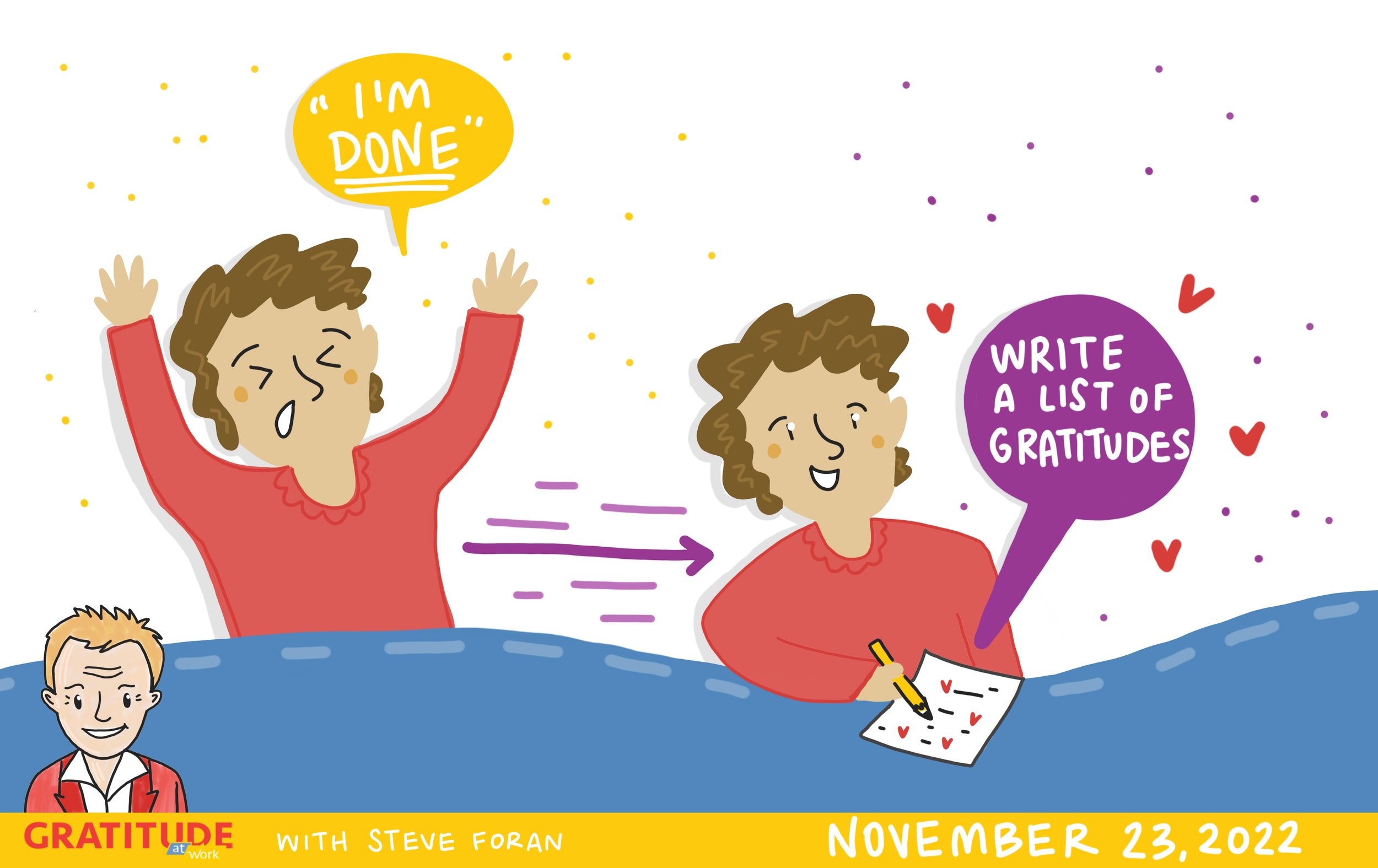
In the past couple weeks, on two separate occasions, two different people were sharing what was going on in their life and the challenges they were dealing with. Eventually they boiled over, “I’m done ! I am so done !”
Both of them used the exact same words and the emphasis in their declarations was identical. I could feel their exhaustion and the blanket of overwhelm that weighed on them.
If you’ve been there, you know the feeling and it’s not a fun place.
In the moment—I just listened and empathized, which I think was the right thing to do.
It got me thinking and I realized I haven’t been in that “done” place in a long time. While I’ve come close recently, I can’t remember the last time I said, “I am so done !”
And I think I know why it’s been so long since I’ve felt that sense of “done”.
And it’s not because I have a special super-power. My life is riddled with challenges and frustration—people disappoint me, people mistreat my loved ones, I fail to achieve personal and professional goals, people don’t follow through as they promised, people don’t return my messages (often the same people)—and I could go on.
My life is far from perfect and I have my moments when I feel overwhelmed but I don’t feel “I am so done.” And I think it’s because of one self-care leadership practice—a practice I do every day and have done every day for at least 13 years. And that practice is:
I make a list of what I’m grateful for.
What do you think ? I’m interested in your experience.
This story from a golf course highlights a common leadership blind spot: we expect others to step forward without considering whether we’ve created the conditions that make it possible.
👉 Watch the full story to discover how great leaders create true belonging 🎥

Leadership is often associated with having the right answers. But in today’s complex world, the real advantage lies in asking better questions and creating space for reflection.
Through years of facilitating executive groups, I’ve seen how removing the pressure to “fix” leads to deeper, more honest, and more impactful insights.
This video explores a simple yet powerful practice you can use immediately with your leadership team.

Most leaders underestimate the impact of what they “go on about.”
During a CEO peer group retreat at North America’s first single malt whiskey distillery, an unexpected voice cut through collective silence. This story explores leadership, group dynamics, and why outsider perspective can be the most powerful force in a room.

Most leaders underestimate the impact of what they “go on about.”
This story-driven video reveals how casual negativity can become a leadership reputation—and shape what your team feels safe to suggest or try.
A simple reminder with big implications for culture and communication.
👉 Watch now ▶️
Leadership often lives in the space between words—and that’s where things quietly fall apart.
This brief, personal story illustrates why clarity is one of the most underestimated leadership skills.
👉 Watch the video 🎥 and explore how to close the gap before gravity does.

Great leadership isn’t always loud or exciting. Often, it’s the quiet consistency that makes people feel safe. In this post, I share a simple family story that reveals why stability is one of the most underestimated leadership qualities—and why protecting it matters more than ever.
▶️🦖 Watch the video

Standing on sacred ground at Vimy Ridge, I realized something essential about leadership: people don’t follow numbers—they follow meaning. This reflection bridges history and modern leadership in a powerful way. 🎥👇
👉 Watch the video and consider the story you’re telling your team.
Organizations rarely “choose” dysfunction. More often, they drift—one copied workaround at a time—until inefficiency becomes the standard operating system. Whether it’s outdated norms, clunky tools, or unnecessary steps, the pattern is the same: when no one questions the default, the default wins.
This video gives you a simple, practical prompt to reset your team: audit one habit they copy from you.
▶️ Watch the video ✅🎬
In 1987, at my first job as an engineer, my boss’s boss—Fraser Blair—felt larger than life. He had a booming voice, a big presence, and a senior title that honestly intimidated me. One day I asked him a simple question about the origin of “Mahone Bay.” That night, at 10pm, he called me at home with the answer. That quiet act of follow-through completely disarmed my fear and built a bridge of trust and camaraderie that changed how I worked.
This experience taught me a lesson I’ve never forgotten: follow-through builds trust faster than authority. In this short video, I share the story and invite you to consider one outstanding commitment you could close today—an email, an introduction, a decision, a promise.
👉 Watch the video below and reflect on how your own follow-through shapes trust at work. 🎥

“Steve, I’ve tried the gratitude list thing… it just doesn’t work for me.”
That’s what a participant told me at a recent gratitude retreat. Her experience is more common than you might think. A lot of people—and a lot of leaders—are faithfully writing gratitude lists that never really touch the heart. The problem isn’t gratitude itself; it’s that we’re only practicing one-third of it.
In this video, I walk through three components of meaningful gratitude:
In the video below, I share how I shifted from vague expectations to a clear, five‑minute integrity talk that spelled out what cheating looked like, what the consequences were, and why it mattered. More importantly, I share the leadership question that changed everything: “What did I not say, clarify, model, or reinforce that might have made this outcome more likely?”
In 1997, I bought a Mother’s Day gift that backfired – and it changed how I lead. I realized that good intentions don’t automatically translate into positive impact. This principle applies to teams, decisions, and relationships. In this post, I share the story and the question every leader should ask before acting.

Leadership isn’t about avoiding challenges—it’s about how you respond when they hit close to home. I learned this after catching a student cheating in an ethics exam. My instinct was personal, but the right response was principle-based. Here’s the full story and the lesson every leader needs.

Why does knowing a process is risky so rarely lead to fixing it? That question sits at the center of this short video from Steve Foran, a professional speaker with a background in safety who spent years removing avocado pits the unsafe way — hand in the line of fire — despite knowing exactly what he was risking.
Emergency rooms have a name for the resulting injury: avocado hand. Steve's shift came not from new information, but from watching a five-second, zero-risk method someone else had been using all along.
The lesson for leaders: awareness of a risk and action on a risk run on separate tracks, and teams tolerate known-flawed processes until they fail. A leader's job is to build the pause between the two.
🎬 Watch now, then take 15 minutes this week to ask your team what risk they've been quietly tolerating.
👉 Watch the full story to discover how great leaders create true belonging 🎥